

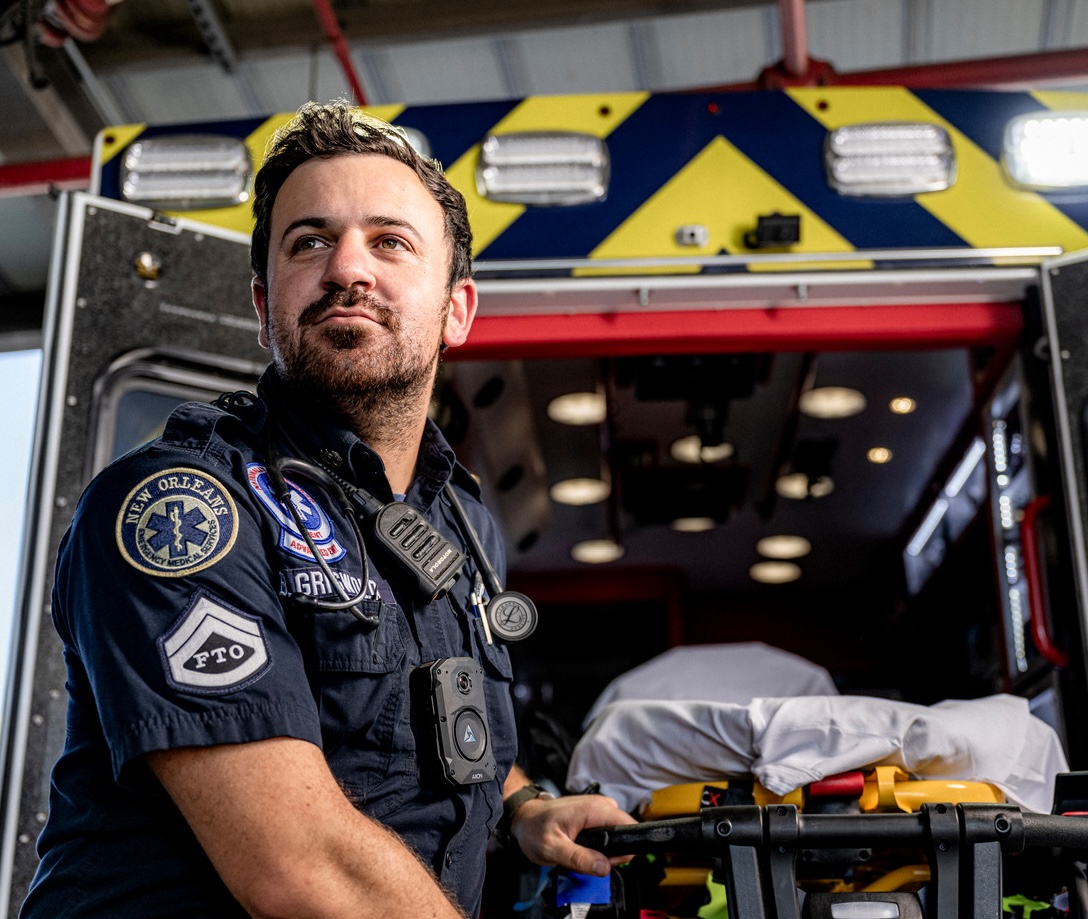









Recently, more EMS workers are being required to wear body cameras. Many people say that this constitutes an invasion of privacy. While others argue that wearing body cams can help in training and improving efficiency over time. While there are pros and cons, there is definitely a limit to what should be allowed; cameras during medical emergencies do not fall on that list. Although body cameras may help EMS workers in some situations, they should not be used during medical emergencies because they violate privacy, reduce patient honesty, and weaken trust.
Numerous articles and websites list the pros of wearing body-worn cameras as enhanced transparency, de-escalating violent situations, reducing false accusations, and more accurate reports. EMS workers often must remember many details after a stressful emergency. Video footage can help workers write more accurate reports and remember what the patient said or what happened at the scene. All of these points are true and would aid in making the life of an EMS worker incredibly easier. Do these pros outweigh the negative points of a body cam?
With body-worn cameras, privacy in emergencies goes out the window. Medical emergencies are not the same as police encounters. The world does not need to know what is going on with your body, especially if you are a minor. Elijah Yoder is a senior at Graham High School who plans to pursue a career in the EMS field. This is what he had to say about the situation: “Bodycams can be an invasion of privacy, especially for minors. Trauma patients are almost always required to be ‘trauma naked’. For minors, this can be uncomfortable, and data leaks can cause mental trauma and other issues.”
With all of the very tight restrictions put on all health care workers, including not sharing any information about the patient’s condition. It is a shock that bodycams are allowed, and even required in some states. You may think that HIPAA would not allow something like this, but it does not violate any conditions or policies. Along with that, if patients know that they are being recorded, they may withhold information. This could cause EMS to incorrectly treat the patient, leading to detrimental outcomes if the patient is using some kind of substance.
This doesn’t even consider the high cost that would come with requiring EMS to wear bodycams. Agencies that require them would have to pay for the camera itself, data storage, reviewing footage, and training. This money could be much better spent on more ambulances, training, equipment, or staffing.
EMS exists to take care of us and to put our trust into saving our lives and not telling our medical business to other people. Turning needed medical treatment into something that is recorded and potentially rewatched completely flips that relationship on its head.